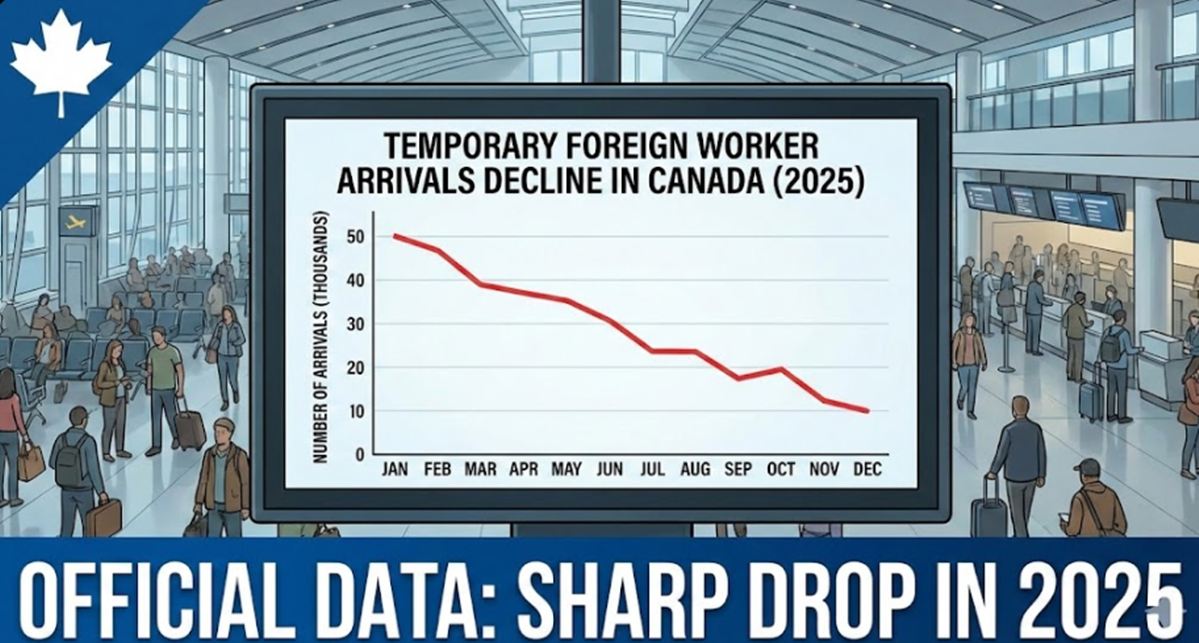
Temporary foreign worker arrivals to Canada declined to their lowest monthly level in nearly two years in November 2025, according to recently published federal data. The contraction reflects a combination of Labour Market Impact Assessment (LMIA) restrictions, lower federal intake targets, and a broader policy shift aimed at moderating temporary resident growth while reinforcing access to employment for Canadian workers.
TFWP arrivals reach lowest point since late 2023
Canada recorded 2,615 new arrivals under the Temporary Foreign Worker Program (TFWP) in November 2025, marking the lowest monthly total observed since the final quarter of 2023. The data, reported by CIC News, confirm a pronounced slowdown compared with 2024, when monthly admissions regularly exceeded 5,000 workers.
The decline is not viewed as cyclical but rather as the outcome of deliberate federal intervention. Since mid-2024, policy instruments have been increasingly deployed to constrain growth in the temporary resident population, which surpassed 2.8 million individuals nationally in early 2025, equivalent to approximately 7% of Canada’s total population.
LMIA restrictions materially reduce employer access
A central factor identified in the contraction has been the suspension of LMIA processing for the low-wage stream of the TFWP in regions where unemployment rates exceed 6%. The measure, implemented in September 2024, currently applies to 24 census metropolitan areas, including Toronto, Calgary, and Ottawa.
As the LMIA functions as a gatekeeping mechanism requiring employers to demonstrate unsuccessful domestic recruitment efforts, the suspension has had an immediate and quantifiable impact on work permit issuance. In affected regions, new low-wage TFWP approvals have declined by an estimated 40% to 50% on a year-over-year basis.
Federal intake targets revised downward
The reduction in arrivals also corresponds with adjustments outlined in the federal Immigration Levels Plan. For 2026, the government has set a target of approximately 60,000 TFWP admissions, representing a reduction of roughly 27% compared with earlier planning assumptions.
These revisions have been advanced jointly by :contentReference[oaicite:0]{index=0} (IRCC) and Employment and Social Development Canada (ESDC), reflecting a recalibration of labour migration following the rapid post-pandemic expansion observed between 2021 and 2024.
Labour market implications for employers and workers
From an employer perspective, particularly within hospitality, accommodation, food services, agriculture, and food processing, reduced access to temporary foreign labour has been associated with persistent vacancy rates. In several provinces, job vacancy ratios in these sectors remain above 4.5%, despite nominal wage growth exceeding 6% annually.
Nevertheless, federal authorities have maintained that the TFWP must operate as a supplementary labour mechanism. It has been emphasized that sustained reliance on temporary foreign workers in regions with elevated unemployment risks suppressing wage growth and limiting labour market attachment among Canadian citizens and permanent residents.
Balancing economic demand and workforce protection
Supporters of tighter program controls argue that recent measures are already contributing to improved labour market conditions for domestic workers, particularly youth and recent graduates. Data from late 2025 indicate modest increases in labour force participation among Canadians aged 20 to 29 in several urban regions subject to LMIA suspensions.
At the same time, demographic constraints persist. Canada’s working-age population growth continues to rely disproportionately on immigration, with natural population increase remaining below 0.3% annually. As a result, policymakers face sustained pressure to maintain targeted labour migration while preventing structural dependence on temporary programs.
Outlook for 2026
Looking ahead, TFWP admissions are expected to remain broadly aligned with revised federal targets throughout 2026. Any material expansion is anticipated to depend on measurable declines in regional unemployment, sector-specific labour shortages, and demonstrated wage adjustments by employers.
In aggregate, the November 2025 figures underscore a structural shift in Canada’s approach to temporary labour migration. The central policy challenge will be ensuring that immigration continues to support economic productivity while preserving equitable access to employment for the domestic workforce, in an environment characterized by demographic aging, housing constraints, and uneven regional labour demand.