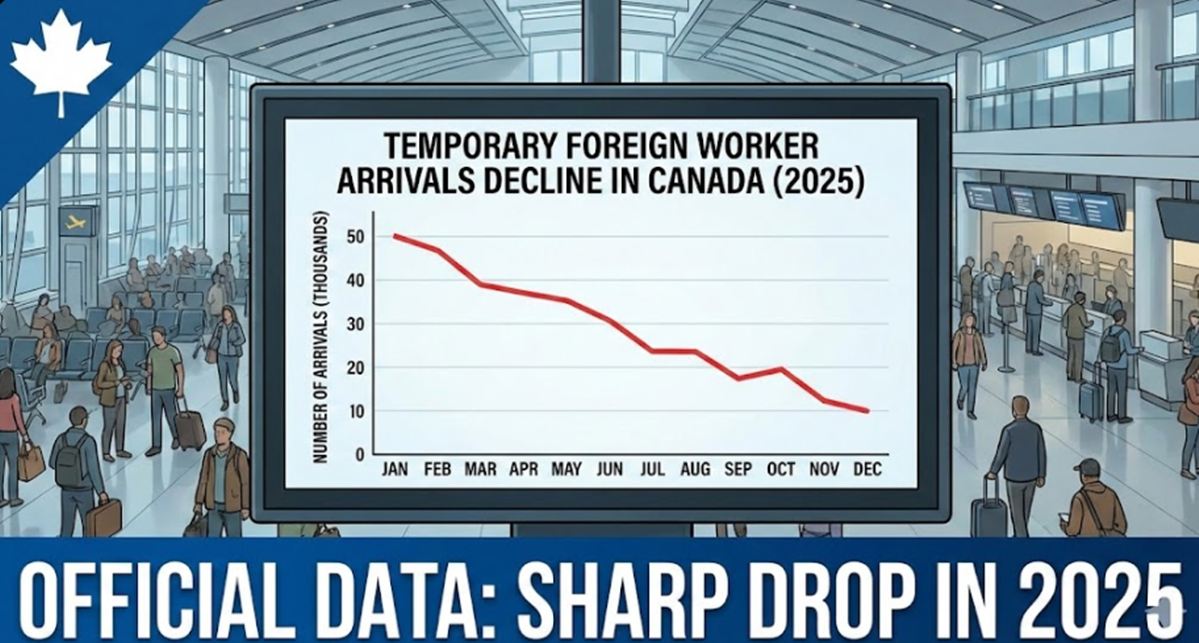
Canada implemented a series of far-reaching immigration policy changes throughout 2025, fundamentally reshaping how temporary and permanent residents are selected, admitted, and retained. While many of the adjustments were introduced incrementally, their cumulative effect represents one of the most significant recalibrations of the immigration system in more than a decade, with direct implications for employers, workers, students, and the domestic labour market.
2025 marked a structural shift in Canada’s immigration framework
Throughout 2025, the federal government advanced a coordinated set of immigration policy reforms aimed at slowing temporary resident growth, restoring system integrity, and aligning admissions more closely with labour market conditions. According to reporting by CIC News, at least 10 major policy changes were implemented across permanent residence, international students, and foreign worker programs.
These reforms occurred against a backdrop of record-high temporary resident levels, which exceeded 2.8 million individuals in early 2025, representing roughly 7% of Canada’s population. Federal authorities repeatedly emphasized the need to rebalance immigration volumes while preserving Canada’s long-term economic objectives.
1. Canada imposed a national cap on international study permits
In a first for the Canadian system, a national cap on new international study permits was introduced, reducing approvals by approximately 35% year over year. Provincial allocations were implemented, with Ontario and British Columbia experiencing the largest absolute reductions.
The measure was justified on the basis of housing availability, institutional oversight concerns, and uneven labour market outcomes among international graduates.
2. Post-Graduation Work Permit eligibility was tightened
Eligibility for the Post-Graduation Work Permit (PGWP) was narrowed through new field-of-study requirements and stricter program alignment rules. As a result, graduates from non-labour-market-aligned programs faced reduced access to open work permits.
The adjustment was intended to better link international education pathways to demonstrable workforce needs.
3. Low-wage LMIA processing was suspended in high-unemployment regions
Employment and Social Development Canada suspended Labour Market Impact Assessment (LMIA) processing for the low-wage stream in regions with unemployment rates above 6%. By late 2025, the restriction applied to 24 census metropolitan areas.
This policy materially reduced employer access to temporary foreign labour in affected regions.
4. Temporary Foreign Worker Program targets were reduced
Federal intake targets for the Temporary Foreign Worker Program (TFWP) were revised downward, with planned admissions for 2026 reduced by approximately 27% compared with earlier projections.
The change reinforced the government’s position that the program should remain supplementary rather than structural.
5. Spousal open work permit eligibility was narrowed
Spousal open work permits were restricted primarily to spouses of high-skilled workers and select international students. The revision reduced overall work permit volumes while prioritizing higher-wage occupations.
6. Express Entry selection became more targeted
Category-based Express Entry draws expanded in scope, prioritizing candidates with experience in healthcare, STEM, skilled trades, transport, and agriculture. General all-program draws became less frequent.
This shift signaled a more interventionist approach to permanent resident selection.
7. Proof of funds requirements were increased
Minimum settlement fund thresholds were raised across several immigration streams, reflecting inflationary pressures and cost-of-living increases. The measure aimed to reduce financial vulnerability among newcomers.
8. Processing integrity measures were strengthened
Additional controls were introduced to combat fraud, including enhanced verification of letters of acceptance, employer compliance audits, and stricter penalties for misrepresentation.
9. Refugee intake planning became more controlled
While maintaining humanitarian commitments, the federal government adopted more predictable multi-year refugee intake planning to better manage housing and settlement capacity.
10. Temporary resident reduction became an explicit policy goal
For the first time, federal planning documents explicitly identified the reduction of temporary resident volumes as a policy objective, with targets set to gradually lower the share of temporary residents relative to the total population.
Labour market implications and policy balance
Collectively, the 2025 reforms reflect a deliberate recalibration led by :contentReference[oaicite:0]{index=0} (IRCC) and partner departments. While employer groups have raised concerns regarding labour availability, federal officials have argued that tighter controls are necessary to protect wage growth and employment access for Canadian workers.
At the same time, the government has reiterated that immigration remains central to Canada’s long-term economic and demographic sustainability, particularly as population aging continues to constrain natural labour force growth.
Outlook for 2026
As these changes take full effect in 2026, immigration outcomes are expected to become more selective, more regionally differentiated, and more closely tied to measurable labour market demand. The policy direction suggests fewer entrants overall, but potentially stronger economic outcomes per admission.
In practical terms, 2025 is increasingly viewed as the year Canada quietly rewrote the operating logic of its immigration system, replacing volume-driven growth with a more controlled and labour-responsive model.